
← Back to DCC Homepage

TOD & Connected Communities Analysis

An urban planning brief detailing how ComEd’s proposed industrial footprint violates Chicago’s transit-oriented development mandates and compromises neighborhood infrastructure funding.

Legal & Urban Planning Conflict

A Violation of Transit-Oriented Development Progress

The Diversey corridor designated Community Area stretches from Lake Michigan to the North Branch of the Chicago River. This land is prioritized for growth, walkability, and density.

By placing a massive industrial transmission hub here, ComEd is creating a permanent “Dead Zone” that directly violates the Connected Communities Ordinance (2022) and established Transit-Oriented Development (TOD) mandates.

The Conflict: These laws require land near transit to be “vibrant, populated, and walkable.” An unmanned complex provides zero of these benefits, sterilizing a prime corridor for generations.

There are better, higher uses for this land that serve the neighborhood’s residential and commercial future rather than ComEd’s regional industrial interests.
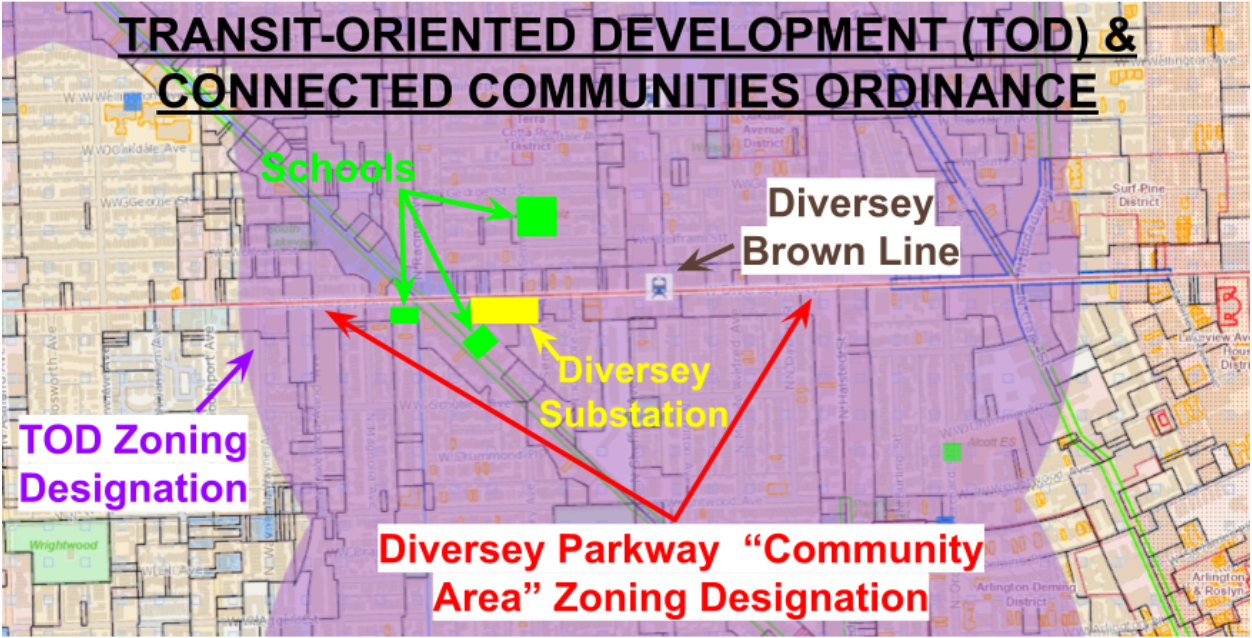
🔍 Click to Enlarge: Analysis of TOD Violation Zones
📊

Our Land, Our Future: The TIF Factor

Understand how this development impacts neighborhood funding structures.

Community Investment Insight

1111 W. Diversey sits within a critical Transit TIF corridor. How we use this land determines whether we fund our future or freeze our progress.

🚀

The TOD Path: Growth

By building Transit-Oriented Housing, we generate massive Incremental Tax to fix sidewalks and support the ‘L’ station footprint.

  • Local Projects: Direct funding for Diversey station accessibility.
  • Post-TIF Windfall: Long-term revenue streams straight to CPS & Public Parks.
🛑

The Substation: Stagnation

An industrial structure is a “low-value” tax asset. It contributes minimal structural tax, effectively starving the local TIF district.

  • Blight Risk: Windowless block arrays suppress surrounding property boundary values.
  • Opportunity Loss: We forfeit 100+ households of economic local tax power forever.

The Bottom Line: Choosing People over Power Equipment ensures our community retains the vital layout resources needed to thrive for generations.

Don’t Let ComEd Freeze Our Land Use

Now that you review the land-use metrics, join the neighborhood in logging a formal objection with the Illinois Commerce Commission.

Take Action: File ICC Comment →