
Decoding ComEd: The Peak Load Misdirection
At our public forum on June 22nd, ComEd presented a frightening slide warning that our local infrastructure is “nearly full” and predicting imminent “brownouts and blackouts.” They are attempting to scare our neighborhood into submission using highly technical phrasing. Let’s look at their actual legal testimony to beat them at their own game.
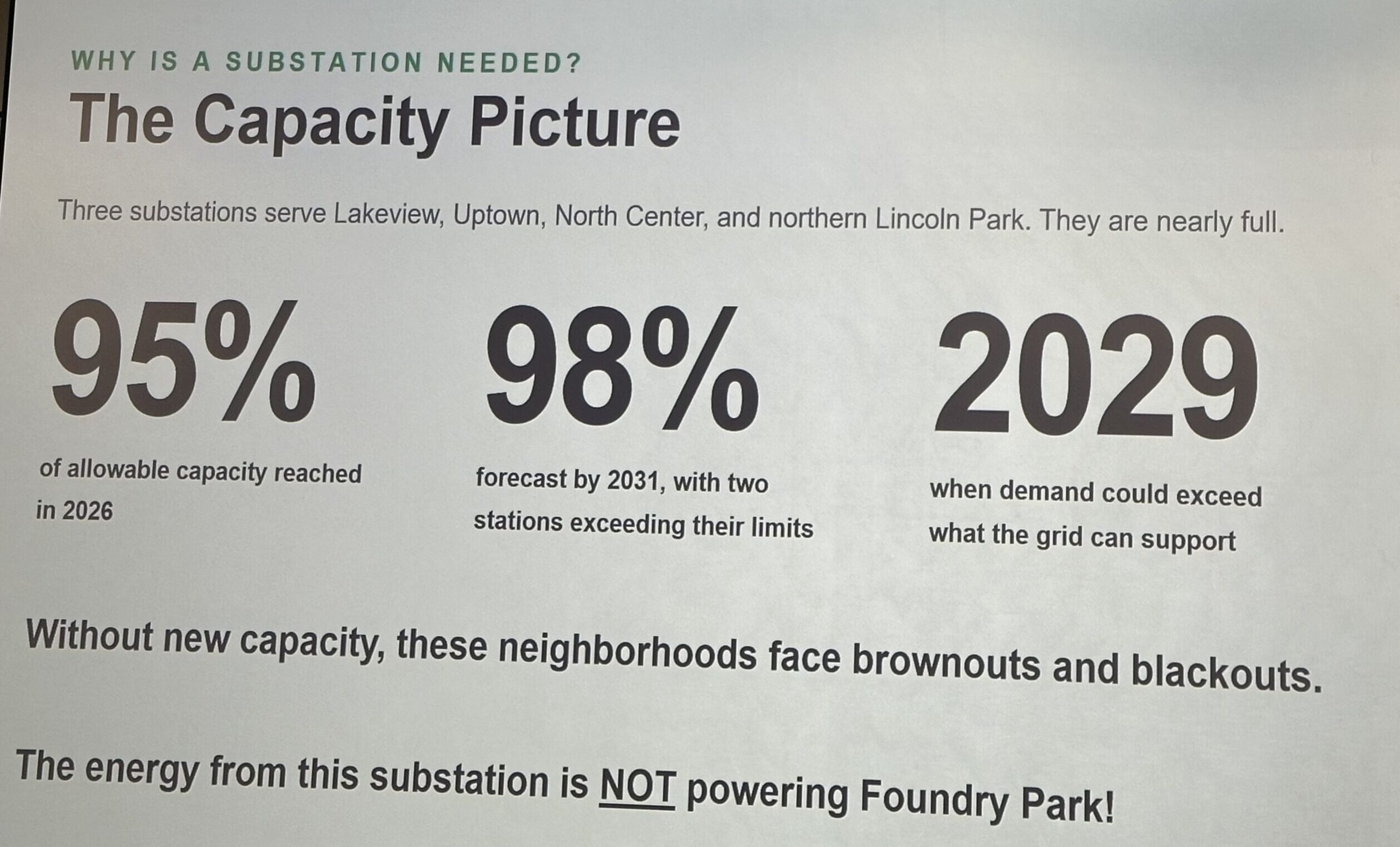
To justify seizing a massive parcel of premium, transit-oriented development land, ComEd witness Morgan Noon submitted the following forecast numbers directly to the state under oath:
“…load in the Northside Neighborhoods is expected to grow to 40,856 amps, or 95% of capacity, by 2026; 41,314 amps, or 96% capacity, by 2027; […] and 42,294 amps, or 98% of capacity, by 2031.”
Jargon vs. Reality
What ComEd Says
“95% of allowable capacity reached by 2026.”
The Reality
This refers strictly to “Peak Demand.” This capacity threshold is only breached during extreme weather—specifically, roughly 4 to 12 hours out of the entire year (8,760 hours total) on the hottest mid-July afternoons when everyone blasts their AC at 3:00 PM. The rest of the year, these stations sit safely under 60% capacity.
What ComEd Says
“Load growing to 42,294 Amps by 2031.”
The Reality
An “amp” is just a raw unit of electrical current. ComEd’s data shows the entire 39-square-mile Northside grid is only projected to grow by a tiny 0.3% per year between 2027 and 2031. They are building a massive infrastructure asset to handle a miniscule trickle of baseline growth.
What ComEd Says
“Without new capacity, these neighborhoods face blackouts.”
The Reality
This is a manufactured ultimatum. Under Illinois’ Climate and Equitable Jobs Act (CEJA), utilities are required to deploy modern Non-Wires Alternatives (NWAs). Instead of massive substations, brief afternoon heatwave spikes can be fully solved using virtual power plants, targeted rooftop solar, and smart-thermostat efficiency programs.
Oversizing the Neighborhood Footprint
ComEd claims they are only using what is required, but their physical site footprints tell a completely different story. They aren’t building a neighborhood asset; they are building a regional mega-fortress right on a pedestrian walking path.
| Substation Location | System Capacity | Physical Land Footprint |
|---|---|---|
| Clybourn Substation (By Costco) | 138kV Industrial Asset | 1.30 Acres |
| Proposed Diversey Substation (1111 W. Diversey) | 138kV Regional Fortress | 1.53 Combined Acres |
The Bottom Line: ComEd is using a brief, 12-hour-a-year seasonal air conditioning spike as an emergency excuse to build an industrial facility larger than the Costco substation right in the heart of our residential corridor. The Illinois Commerce Commission (ICC) should force ComEd to deploy 21st-century clean energy alternatives rather than permanently killing affordable transit housing.